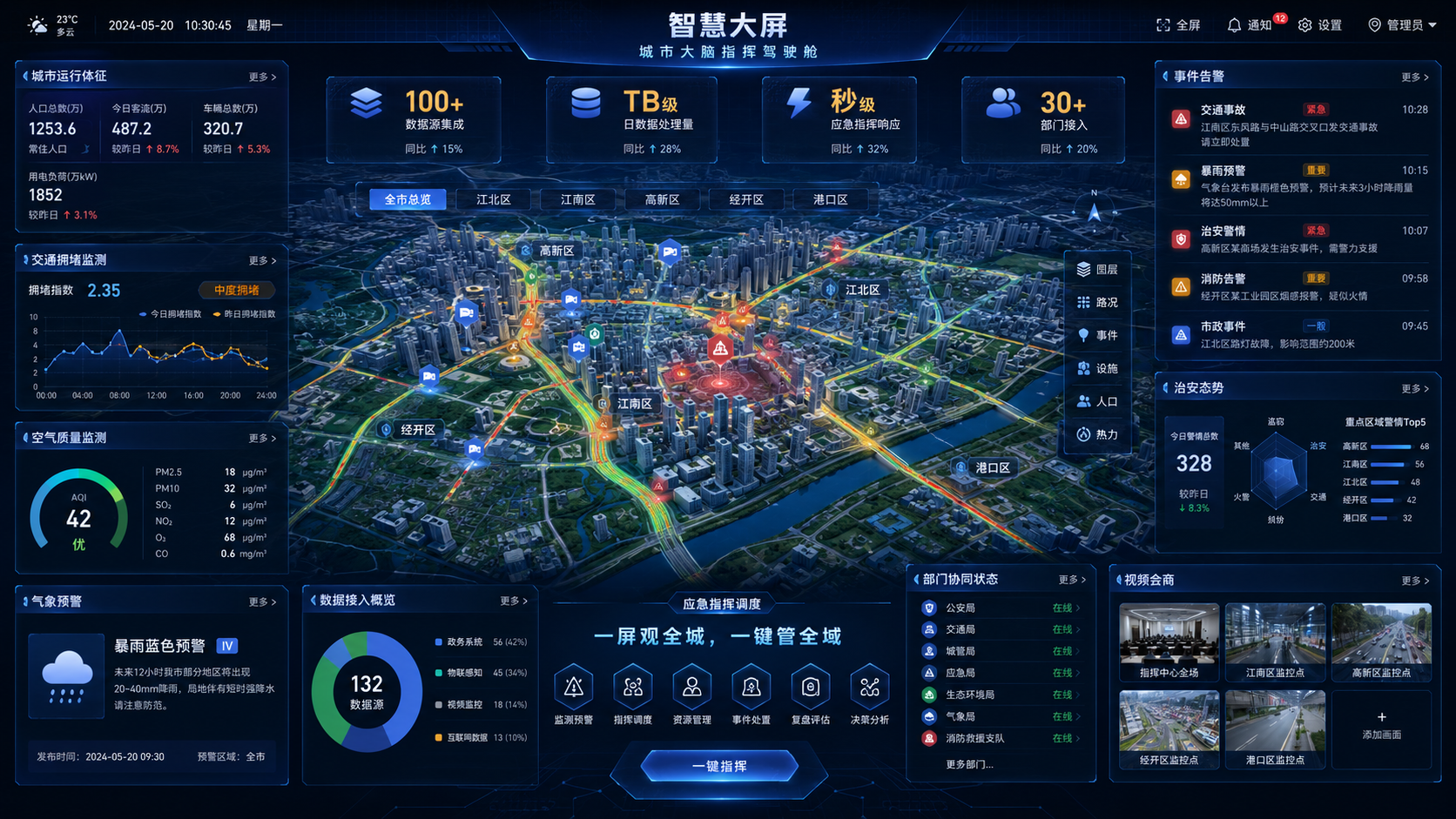
100+
Data Source Integration
TB-Level
Daily Data Processing Volume
Second-Level
Emergency Command Response
Project Background
During digital transformation, a municipal government faced severe data barriers among agencies and lacked a unified city operations monitoring platform. In emergencies or major events, decision-makers struggled to obtain timely, comprehensive data, hindering command efficiency.
Solutions
Leveraging digital twins and big data, we built a “city brain” command cockpit:
- Multi-source Heterogeneous Data Integration: Connected over 100 data sources across 30+ departments including public security, transportation, environmental protection, and meteorology to form a unified city big data pool.
- Real-time Computing & Analytics: Supported real-time ingestion and processing of terabyte-scale data to monitor city operational vital signs (traffic congestion, air quality, public security, etc.).
- Ultra-HD Visualization: Used WebGL and 3D GIS to build a three-dimensional city panorama, supporting drill-down from city-wide macro views to building-level micro views.
- Intelligent Command & Dispatch: Integrated video conferencing and converged communications to achieve “one screen for the whole city, one click to control the entire area”.
Implementation Process
The project followed a “urgent needs first, phased construction” principle:
- Indicator System Design: Worked closely with business departments to establish a core indicator framework for city operations monitoring.
- Data Governance & Ingestion: Completed cross-department data cleansing, transformation, and warehousing.
- Visual Design & Development: Refined UI/UX through multiple iterations to achieve a visualization that balances tech appeal and practicality.
Key Outcomes
The smart city dashboard has become the “super brain” of urban management:
- Successfully safeguarded multiple national-level major events with zero mistakes.
- Emergency response time shortened by 50%, significantly improving cross-department collaboration.
- Provided strong data support for scientific decisions, advancing the modernization of city governance capabilities.
Value Proposition
The project broke data silos and made data “speak” through visualization, enabling smarter, more transparent, and efficient city management.