Project Background
In telecom network construction, the optical-cable routing plan directly affects investment intensity, construction timeline, later maintenance cost, and line-operation safety. Traditional routing design relies on experience and lacks comprehensive analysis of terrain, construction conditions, natural-disaster risk, public-security environment, rodent damage, over-height-vehicle snapping, and later repair accessibility — leaving route selection and the aerial-versus-buried decision without fine-grained support.
To address this, the client wanted an intelligent optical-cable routing decision system for telecom engineering scenarios — bringing map, cost, safety, and construction-difficulty factors into a unified model, recommending routes for designated areas, and providing quantitative support for aerial and buried options.
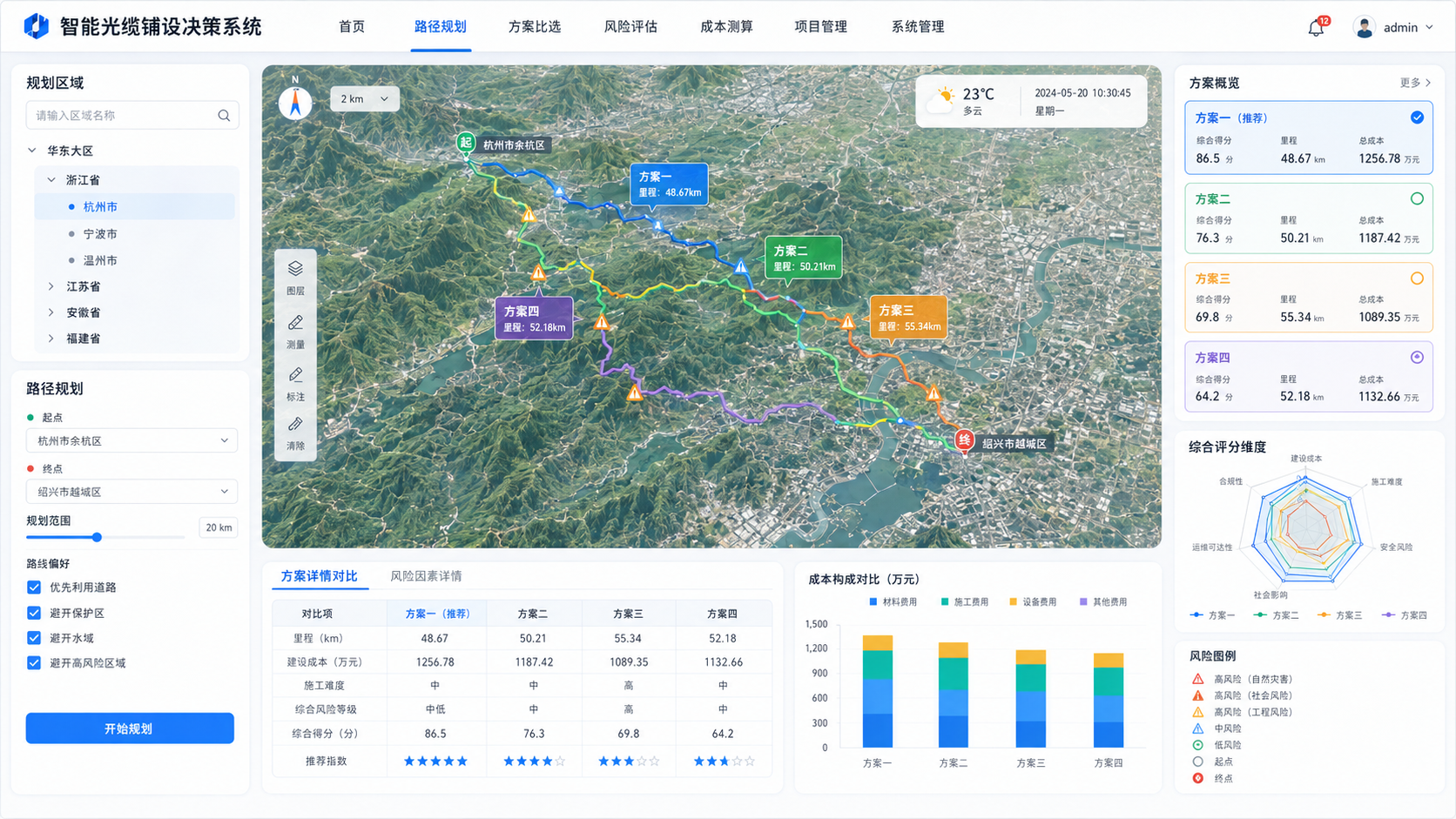
Solutions
Luxijie built the intelligent cable-routing solution around "mapping + route modeling + cost estimation + risk assessment," providing digital support from route analysis to plan recommendation. Core capabilities:
1. Digital modeling of cable routes
Using the map as a base, the planned cable line is abstracted into continuous route points and analyzed segment by segment, forming a computable, comparable routing model.
2. Aerial-vs-buried comparison mechanism
The system weighs the cost differences, construction conditions, and safety risks of aerial and buried construction, building a multi-dimensional evaluation model rather than deciding on cost alone.
3. Multi-factor risk-assessment model
It quantitatively evaluates terrain, flash-flood and landslide risk, public-security risk, rodent risk, over-height-vehicle snapping risk, strong-interference factors, construction difficulty, and later repair accessibility, providing a scientific basis for route selection.
4. Area-level route recommendation
For a local area, the system can automatically score one or more candidate route segments and output a better-recommended plan, supporting engineering planning and investment decisions.
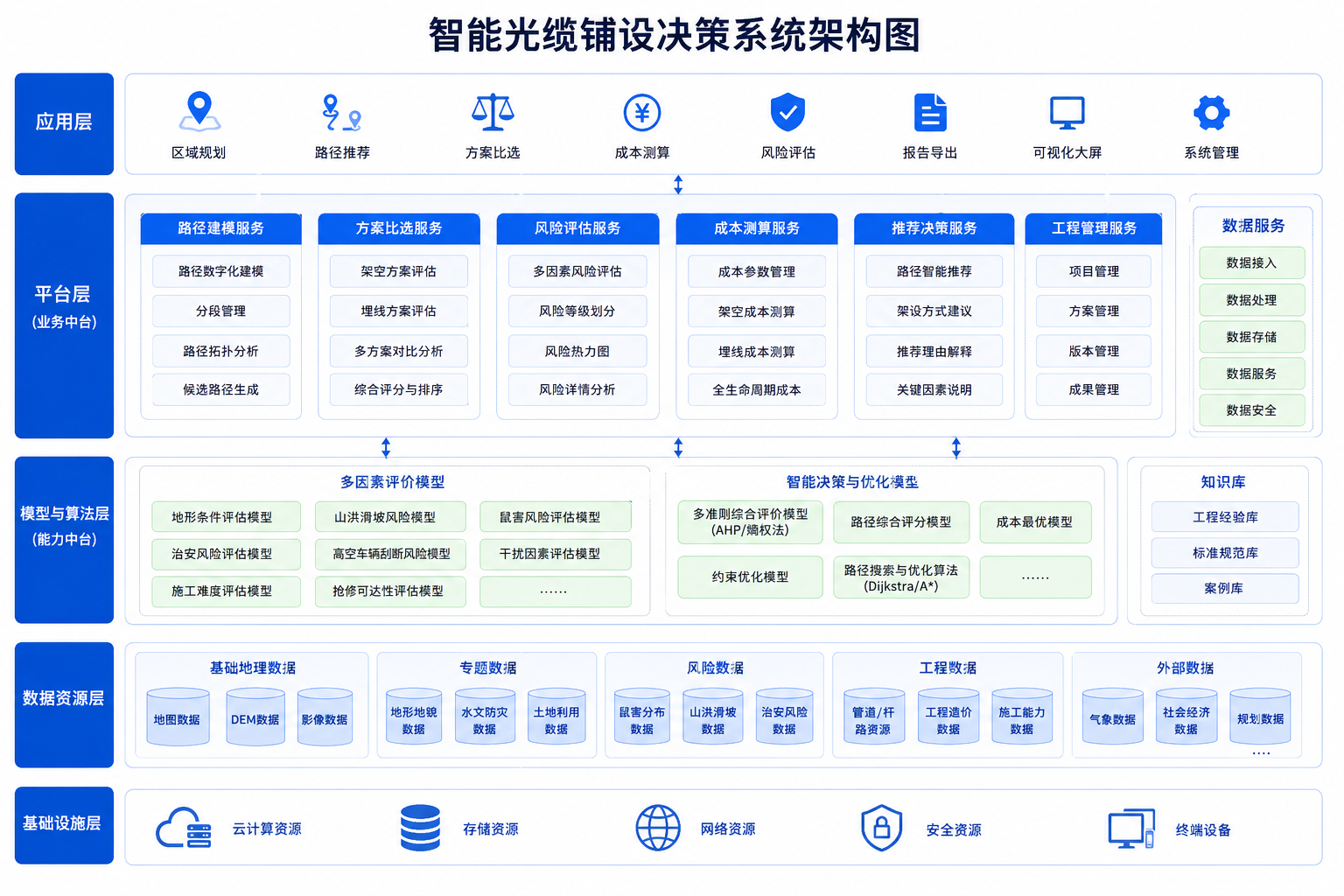
System Architecture Diagram
Implementation Process
Implementation followed a "requirements mapping → model design → factor quantification → plan recommendation" approach:
Phase 1: Scenario decomposition
Around the key decision points in cable routing, the team identified four core factor categories — cost, construction, safety, and operations — with particular focus on the differentiated costs and risk constraints of aerial versus buried construction.
Phase 2: Routing rules and indicator system
The key factors affecting routing — terrain, rodent damage, mountain flash floods, over-height-vehicle snapping, public security, construction difficulty, interference, and more — were structured into a quantifiable evaluation indicator system.
Phase 3: Map and route-recommendation logic
Map information was linked with candidate routes; combined with the cost structure and safety-assessment results, the system performs route comparison and recommendation for selected areas, improving the objectivity and explainability of planning.
Phase 4: Planning-oriented output
The system outputs aerial/buried recommendations, route-recommendation results, and explanations of the key decision factors, providing a reference for the client's feasibility study, design review, and investment-decision stages.
Key Outcomes
The project established an intelligent routing-decision framework for telecom engineering scenarios. Key results:
- a map-based digital representation of optical-cable routes;
- a comprehensive comparison approach for aerial versus buried construction;
- a unified evaluation logic incorporating terrain, flooding, public security, rodent, over-height-vehicle, and other risk factors;
- support for route recommendation and plan optimization in local areas, improving planning efficiency.
Value Proposition
The project upgraded experience-dependent cable-routing design into a quantifiable, comparable, and explainable intelligent decision process.
For the client, the system helps reduce investment waste from routing mistakes and identifies potential risks more fully in the early construction phase, balancing cost, safety, and later-maintenance accessibility.
By introducing mapping and intelligent-recommendation capabilities, the client can validate routing plans more efficiently and raise the rigor and precision of engineering planning, providing more robust decision support for telecom network construction.