Project Background
As enterprises accumulate more and more digital systems, business teams face rapidly growing demand for AI across customer service, complaint handling, operations management, data analysis, and knowledge Q&A. Traditionally, AI capabilities are embedded into individual systems as one-off features, leading to duplicated development, high integration costs, poor reusability, hard-to-measure results, and uncontrolled permissions and security.
Drawing on real business scenarios, Wuhan Luxijie Technology Co., Ltd. built an enterprise-oriented AI Service Platform that acts as a unified AI capability layer, providing reusable, extensible, and governable intelligent capabilities to the complaint pre-processing system and many other business systems.
The platform not only solves intelligent generation, analysis, and Q&A within a single business system, but also lays the foundation for the enterprise to build a broader AI application ecosystem.
Solutions
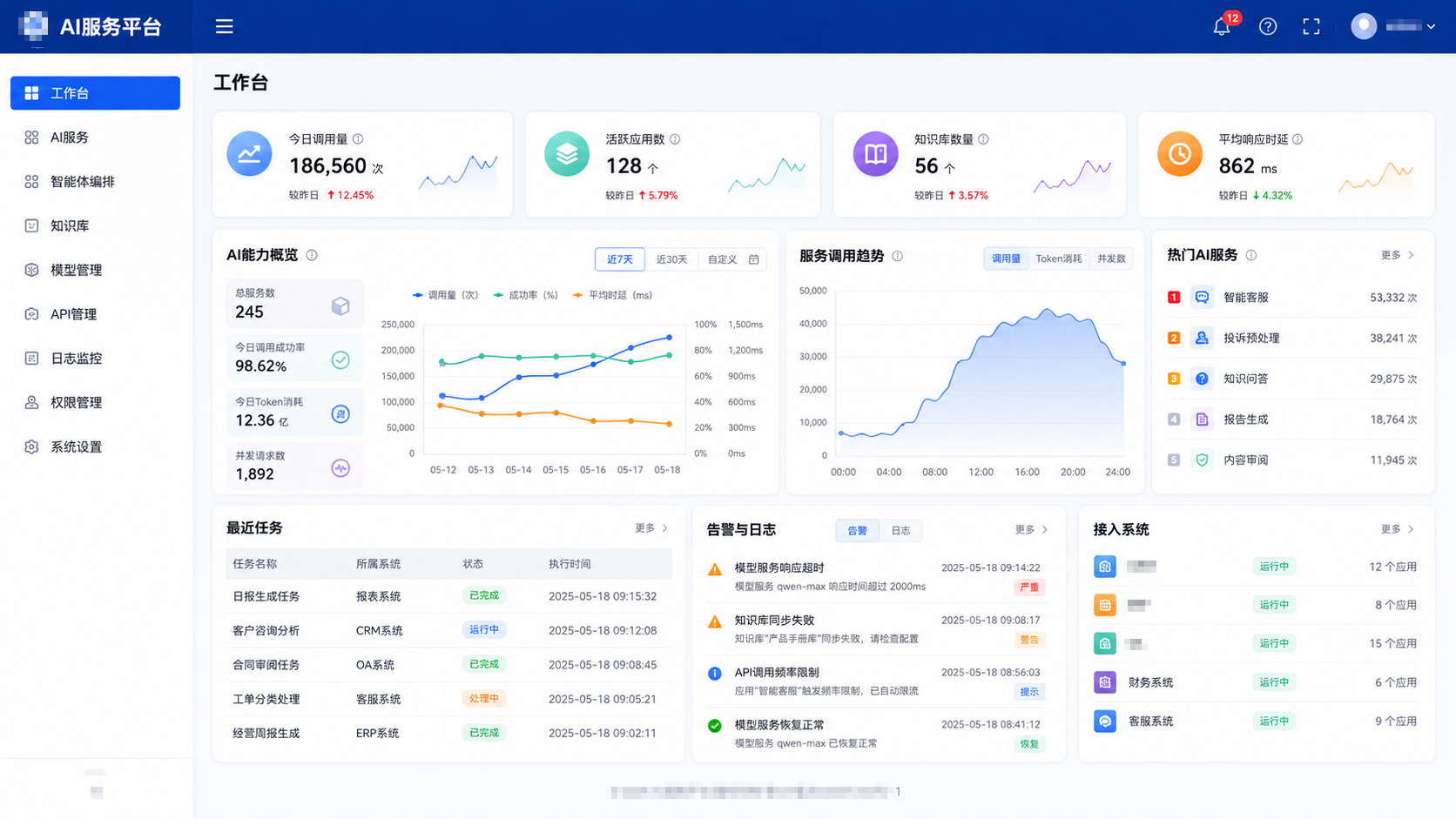
Luxijie adopted an "AI capability platform + business system integration" approach, encapsulating large-model capabilities, business knowledge, process rules, and system interfaces into standardized AI services. The platform's core capabilities include:
1. Unified AI capability access
The platform provides a single point of access to large language models and agents, exposing standardized APIs to every business system. Systems no longer integrate models repeatedly; one unified interface delivers text generation, content analysis, knowledge Q&A, and decision support.
2. Scenario-driven agent orchestration
For complex scenarios such as complaint pre-processing, the platform combines multiple business interfaces, rule checks, knowledge-base retrieval, and large-model reasoning into task-specific AI agents. In complaint pre-processing, for example, the AI drafts handling suggestions, summarizes key issues, detects duplicate complaints, and recommends next steps based on ticket content, history, business rules, and processing standards.
3. Explainable AI generation
Beyond the generated result, the platform surfaces the basis, references, reasoning, and a result preview, helping staff understand how the AI reached its output, reducing the black-box feeling, and increasing trust in AI results.
4. Cross-system reusability
Built on a standardized service architecture, the platform can serve complaint pre-processing, customer service, operations management, the knowledge base, and data analysis at the same time, avoiding duplicated AI development across systems.
5. Permissions, security, and auditing
The platform supports user access control, call logging, generated-content auditing, and interface access control, meeting enterprise requirements for internal management, data security, and compliant usage.
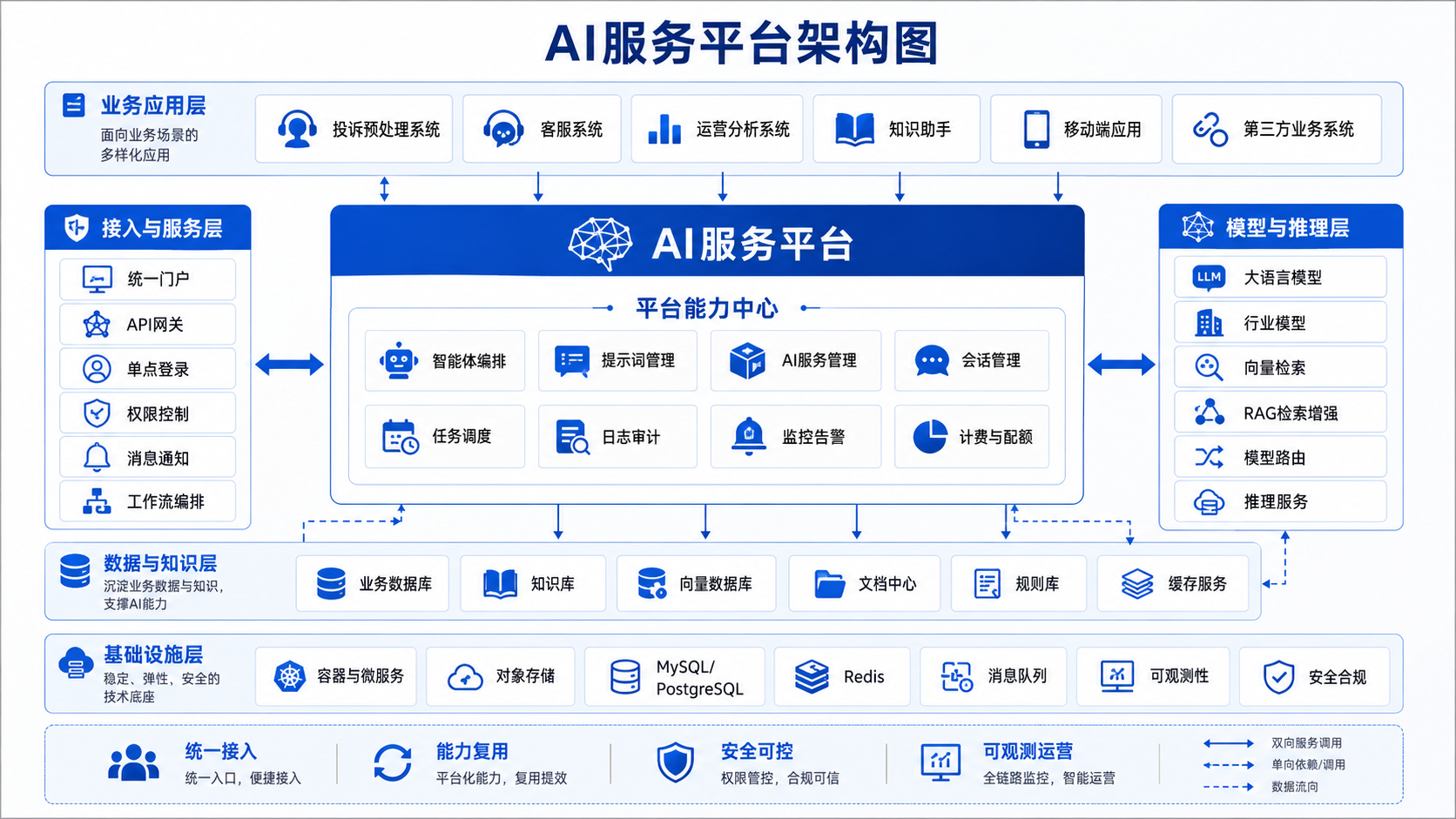
System Architecture Diagram
Implementation Process
Phase 1: Business scenario mapping
The team first mapped the enterprise's high-frequency business scenarios and identified where AI could add value, including:
- complaint summarization and classification;
- ticket handling-suggestion generation;
- business-rule decision support;
- historical case retrieval;
- automatic drafting of handling opinions;
- user-feedback content analysis;
- knowledge-base Q&A and policy interpretation.
By decomposing the workflows, the team clarified which steps suit AI-assisted generation, which require human review, and which must integrate with existing business-system interfaces.
Phase 2: Platform architecture design
The architecture follows a decoupled front-end/back-end, service-oriented design:
- the front end offers AI-service configuration, call display, result preview, and log viewing;
- the back end unifies AI invocation, task orchestration, access control, and business-system interfaces;
- large-model capabilities are accessed through a unified service layer;
- business systems call platform capabilities via standard APIs;
- knowledge bases, rule bases, and business interfaces serve as key context for AI reasoning.
This architecture gives the platform strong extensibility: adding new scenarios later requires only configuring new capability modules or agent flows, not rebuilding full AI functionality.
Phase 3: Core feature development
Guided by three goals — usable, trustworthy, and reusable — the team delivered:
- a unified AI-invocation module;
- an agent task-orchestration module;
- a business-system interface integration module;
- a knowledge-retrieval and context-augmentation module;
- an AI result-display module;
- a user-permission and call-audit module;
- a runtime-log and effectiveness-tracking module.
An "AI generate" button was embedded directly into business-system pages, letting staff invoke AI right next to the relevant field — using AI within the workflow rather than switching to a separate tool.
Phase 4: Business system integration
The platform was first integrated with the complaint pre-processing system, embedding AI into the ticket-handling workflow. In daily operations, staff can generate a complaint summary, problem assessment, handling suggestion, and reply draft from the ticket content in one click. AI output never replaces human decisions; it is presented as assistive suggestions that staff confirm or revise before the workflow proceeds.
This improves efficiency while preserving staff's review authority and final judgment, making it better suited to enterprise-grade adoption.
Phase 5: Continuous optimization and reuse
After the first scenario went live, the platform continuously refined prompts, knowledge-base content, agent flows, and interface-calling strategies based on real usage, gradually consolidating them into reusable AI services. It can be further extended to customer-service Q&A, operations analysis, an internal knowledge assistant, contract-document review, data-report interpretation, and more.
Key Outcomes
The AI Service Platform delivered the following milestone results:
1. A unified AI capability foundation
Previously scattered AI capabilities were consolidated into a platform layer, forming a reusable AI services hub that provides unified support to multiple business systems.
2. Lower cost of adding AI to business systems
Business systems no longer integrate large models and agents individually; calling the platform's standard interfaces is enough to gain AI support quickly.
3. Higher business-processing efficiency
In complaint pre-processing, AI assists with content summarization, issue classification, and handling-suggestion generation, reducing repetitive manual entry and time spent looking up information.
4. More trustworthy AI output
By showing the generation basis, references, and reasoning, staff can understand where AI output comes from, improving its acceptance in real business.
5. A foundation for continued AI expansion
With strong extensibility, the platform can quickly add new AI scenarios for different departments, gradually forming an internal enterprise AI application ecosystem.
Value Proposition
Value for business teams
The platform frees staff from repetitive, low-value information gathering so they can focus on judgment, customer communication, and complex cases. Through smart summarization, decision support, and automatic suggestion generation, it raises efficiency and standardization and reduces inconsistencies caused by differences in individual experience.
Value for management
The platform retains AI call records, processing steps, and generated content, giving management a traceable, analyzable, and optimizable data foundation. By continuously analyzing AI usage, processing efficiency, and issue types, the enterprise can refine workflows, improve knowledge bases, and uncover management improvements behind high-frequency issues.
Value for IT
The platform encapsulates model access, permission control, log auditing, interface integration, and agent orchestration in one place, reducing duplicated development across systems and lowering ongoing maintenance and expansion costs. IT can manage enterprise AI capabilities through a single platform, improving architectural consistency, security, and maintainability.
Value for the enterprise as a whole
This project is not just an AI feature build but a key piece of infrastructure for the enterprise's intelligent transformation. Through the platform, the enterprise can progressively embed large-model capabilities into core processes — customer service, operations, management, risk control, and knowledge management — advancing from "digitalization" to "intelligence."